
Table of content
INTRODUCTION
If you're a financial advisor consideringa transition to a new firm or independent practice, understanding thedistinction between protocol and non-protocol firms is essential for making aninformed decision.
This guide provides educationalinformation about these two different environments and what advisors shouldconsider when evaluating career moves.
WHY ADVISORS CONSIDER TRANSITIONS
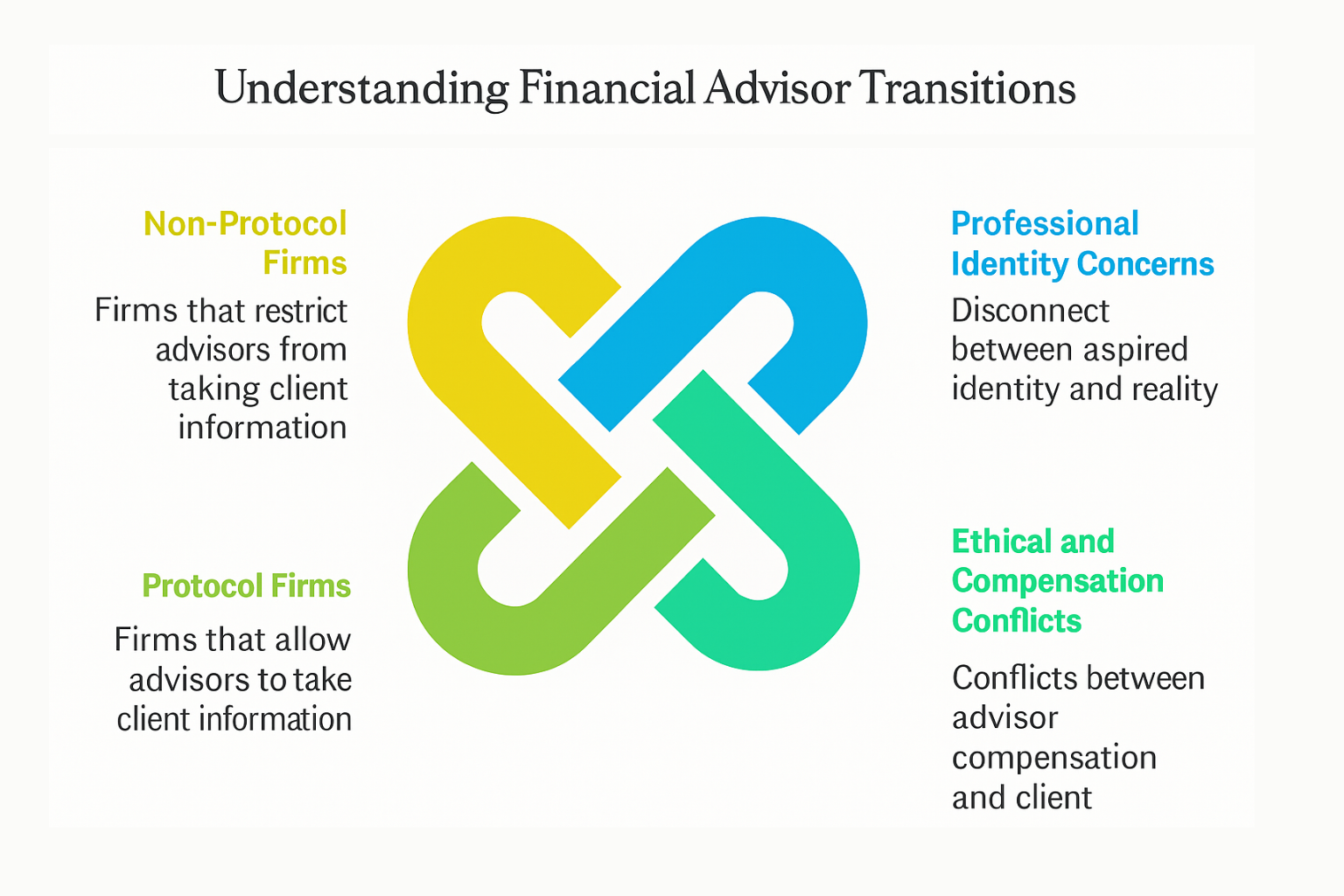
Based on our research with financial advisors in transition, several common themes emerge regarding why advisors begin exploring alternatives to their current firms:
Professional Identity Concerns
According to our Advisors in Transition research, many advisors experience what researchers describe as "Advisor Identity Fracture" - a disconnect between their aspired professional identity as a "trusted financial advisor" and their lived reality in commission-driven environments. Advisors in our research frequently described entering the profession with a vision of becoming trusted family advisors who guide clients through major financial decisions, only to discover they're primarily evaluated on monthly production numbers and product sales.
Ethical and Compensation Conflicts
Our research identified recurring themes around compensation structures that create conflicts between advisor compensation and client best interests. Advisors consistently expressed concerns about:
● Being rewarded for selling proprietary products regardless of client suitability
● Restricted access to best-in-class solutions that don't generate firm revenue
● Job descriptions that emphasize "solicitation, sale, and servicing" of products over comprehensive financial planning
Income Volatility and Sustainability
Advisors in our research frequently cited income unpredictability as a major source of stress. The commission-based model creates what many described as a "monthly starting over" scenario, where production resets each month regardless of the work done building client relationships in previous periods.
Desire for Recurring Revenue Models
A recurring theme in our research was advisors seeking to transition from commission-based to recurring revenue models. As one advisor in our research stated, recurring revenue allows advisors to "meet with your clients on an ongoing basis, which is what they expected in the first place" rather than being trapped on "a commission based treadmill."
UNDERSTANDING BROKER PROTOCOL
What Is Broker Protocol?
The Broker Protocol (formally called "The Protocol for Broker Recruiting") is an agreement among certain financial services firms designed to create a framework for advisor transitions between member firms.
For advisors at protocol member firms, the agreement provides specific guidelines about what client information can be taken when transitioning to another protocol firm.
What Protocol Typically Allows (When Properly Followed)
At protocol member firms, advisors generally may take limited client information when transitioning, which typically includes:
● Client name
● Client address
● Client phone number
● Client email address
● Client account title/type
What Cannot Be Taken
Regardless of protocol status, advisors cannot take:
● Account numbers
● Account values or balances
● Investment holdings details
● Transaction history
● Client financial information
● Client personal notes or documents
● Any proprietary firm information
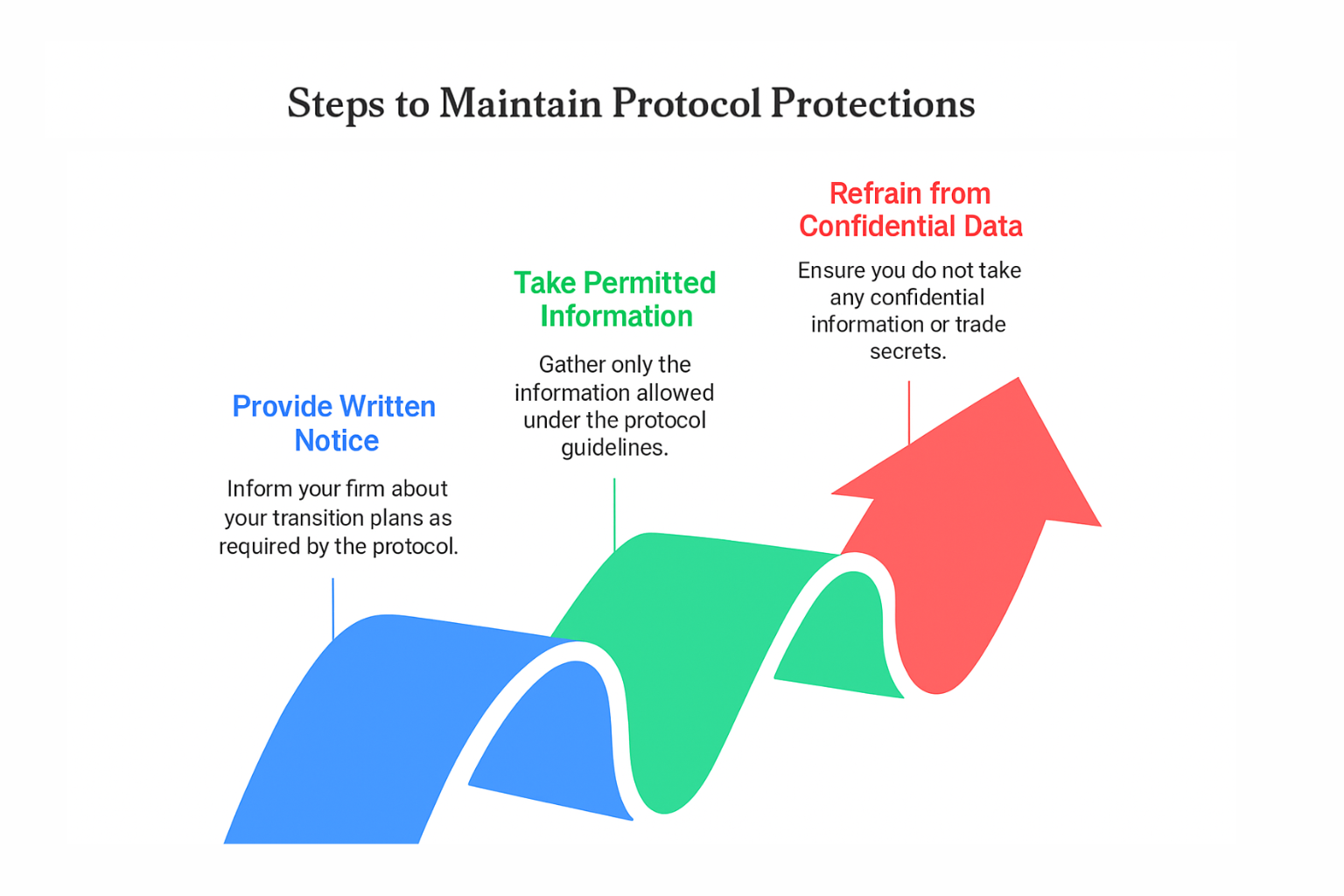
The Basic Protocol Requirements
To maintain protocol protections, advisors typically are required to:
Provide written notice to their firm as specified in the protocol
Take only the permitted information listed above
Refrain from taking any confidential information or trade secrets
PROTOCOL VS NON-PROTOCOL FIRMS:UNDERSTANDING THE LANDSCAPE
Understanding Your Firm's Status
The first step in planning any transition is understanding whether your current firm is a protocol member. This status can change, so advisors should verify current protocol membership before making any transition plans.
General Categories
Protocol Firms typically include:
● Many major wirehouses
● Independent broker-dealers
Non-Protocol Firms typically include:
● Many insurance-focused companies
● Some major firms that have left the protocol
● Firms that never joined the protocol agreement
According to our Advisors in Transition research, advisors leaving non-protocol firms face additional complexity in transition planning, including:
● Inability to take any client information
● Must rely on public announcements rather than direct client communication
● Extended timelines for client contact and relationship re-establishment
● Heightened legal scrutiny and potential litigation risk
Important Note: Specific firm protocol status should be verified with legal counsel, as firms can join or leave the protocol at any time.
COMMON ADVISOR CONCERNS ABOUT TRANSITIONS
Based on our research with advisors considering transitions, several objection patterns consistently emerge:
Financial Concerns
Advisors in our research expressed significant anxiety about:
● Transition costs and legal fees
● Income interruption during transition period
● Family financial security during uncertainty
● Return on investment timeline expectations
Our research found that advisors typically need to see income recovery within 18-24 months and positive ROI within 36 months to justify transition costs in their planning.
Operational Complexity
Advisors consistently raised concerns about:
● Managing compliance independently
● Technology platform transitions
● Administrative burden increase
● Business management versus financial planning expertise
As one advisor in our research stated: "I'm good at financial analysis, not business operations."
Client Retention Anxiety
A recurring theme in our research was advisors projecting their own uncertainties about transitions onto their clients. Common concerns included:
● "Will my clients understand why I'm leaving?"
● "Do I have enough credibility to ask clients to follow me?"
● "What if they stay with the firm's brand rather than following me?"
Validation Requirements
Our research revealed that advisors typically require significant external validation before committing to major career changes, including:
● Testimonials and case studies from advisors with similar backgrounds
● Peer references who can provide realistic expectations
● Industry recognition and third-party validation
● 3-5 advisor conversations over 6-12 months before internal conviction develops
THE ROLE OF LEGAL COUNSEL IN ADVISORTRANSITIONS
Why Specialized Expertise Matters
The regulatory and legal landscape for advisor transitions is highly specialized. Our research identifies using general practice attorneys rather than specialized legal counsel as a common mistake that advisors frequently make when planning transitions.
Critical Legal Considerations
All advisor transitions should include review of:
● Employment agreement provisions and restrictions
● Non-compete and non-solicitation clauses
● Client communication boundaries and timing
● State-specific regulations and requirements
● Potential litigation risks and defense strategies
Questions to Ask Potential Legal Counsel
Based on our research with advisors who've completed transitions, important questions include:
● How many advisor transitions have you personally handled?
● Have you worked with advisors leaving my specific firm?
● What are the specific risks in my employment agreement?
● What strategy do you recommend for my situation?
● What are realistic timelines and cost expectations?
COMMON TRANSITION PLANNING MISTAKES
Based on our research, advisors frequently make several avoidable mistakes:
Mistake #1: Inadequate Planning Time
Our research indicates that successful transitions typically involve:
● 6-12 months of pre-transition relationship strengthening
● 90-180 days of legal consultation and planning
● Systematic operational setup
● Post-transition client communication strategy
Rushing this timeline creates unnecessary risk.
Mistake #2: Weak Relationship Building
Advisors in our research emphasized that strong client relationships built before transition are essential for success. Clients need sufficient relationship strength to choose to follow their advisor rather than remaining with the firm brand, which requires investing in authentic relationships before transition.
Mistake #3: Using General Legal Counsel
The regulatory and legal landscape for advisor transitions is highly specialized. Our research consistently identifies using general practice attorneys rather than specialized legal counsel as a common mistake that can create unnecessary risks and complications.
Mistake #4: Poor Financial Planning
Transitions often involve periods of reduced income or unexpected costs. Our research found that advisors who created comprehensive financial plans and income bridges before transitioning reported significantly less stress.
Mistake #5: Not Understanding Employment Agreements
Many advisors in our research admitted they didn't fully understand the restrictions in their current employment agreements until they began planning transitions. Early review with specialized counsel is essential.
INDUSTRY RESEARCH: WHY ADVISORS LEAVEMAJOR FIRMS
Our Advisors in Transition research examined advisor experiences at various firm types. Here are documented pain points by firm category:
Wirehouse Firms
According to our research, common advisor concerns include:
● Compensation structure changes and deferred compensation policies
● Sales-oriented culture versus advisory culture
● Limited autonomy over client portfolio management
● Pressure for product sales over comprehensive planning
Insurance-Focused Companies
Our research documented specific concerns including:
● According to Diamond Consultants research, 80% of this category of recruits leave within the first 5 years
● Nearly 1,000 financial advisors have changed firms in recent years
● Culture constraints limiting comprehensive financial planning
● Pressure to sell proprietary products
● Limited investment options for high net worth clients
Independent Broker-Dealers
Advisors in our research cited:
● Compliance burden complexity
● Technology platform limitations
● Fee structures and transparency concerns
● Desire for greater independence and control
TRANSITIONING TO AXIOM: OUR DOCUMENTEDMODEL
The Recurring Revenue Advantage
According to our internal documentation, Axiom's organization generates 97% recurring revenue compared to what we understand to be an industry average of approximately 32%.
This recurring revenue model may support more predictable, sustainable practices focused on ongoing client relationships rather than continual new product sales.
As documented in our founder interviews:
"The recurring revenue model means you meet with your clients on an ongoing basis, which is what they expected in the first place. Most people aren't doing it because most people are still on a commission based treadmill."
Our Philosophy and Values
According to our documented tone of voice and organizational philosophy:
● True Ownership: Advisors own their client relationships and build equity in their practices
● Ethical Practice: Compensation model aligned with ongoing client service rather than product sales
● Collaborative Culture: Supportive peer environment rather than competitive pressure
● Professional Growth: Focus on advisor development and long-term success
What We Believe About Advisor Freedom
As documented in our founder's writings:
"We passionately believe in financial freedom for advisors. We believe there is one major event to celebrate, and that is when recurring fees and renewals are equal or greater than the sum of the advisor's personal and business expenses. We believe advisors get into this business to do well for themselves and also to do well for others."
Our Support Philosophy
We believe in providing comprehensive support for advisors making transitions, including:
● Connection to specialized legal counsel who understand advisor transitions
● Operational support to handle administrative burdens
● Practice management guidance
● Peer community and mentorship
● Business development resources
Documented Advisor Experience
According to documented advisor testimonials in our research:
One advisor who transitioned to our organization stated: "The promises that were made to me on the front end have all been delivered on. It's thankfully our firm is not a 'let's over promise and under deliver.' It is very much, 'Hey let's give you conservative goals and estimates.' And quite frankly, I have outperformed all those coming into it."
Another advisor documented: "I've done this for five years now, and I would just like to say that I'm living proof that there is a better model, a better structure. In my opinion, I think fee based planning is the wave of the future."
UNDERSTANDING THE DECISION TIMELINE
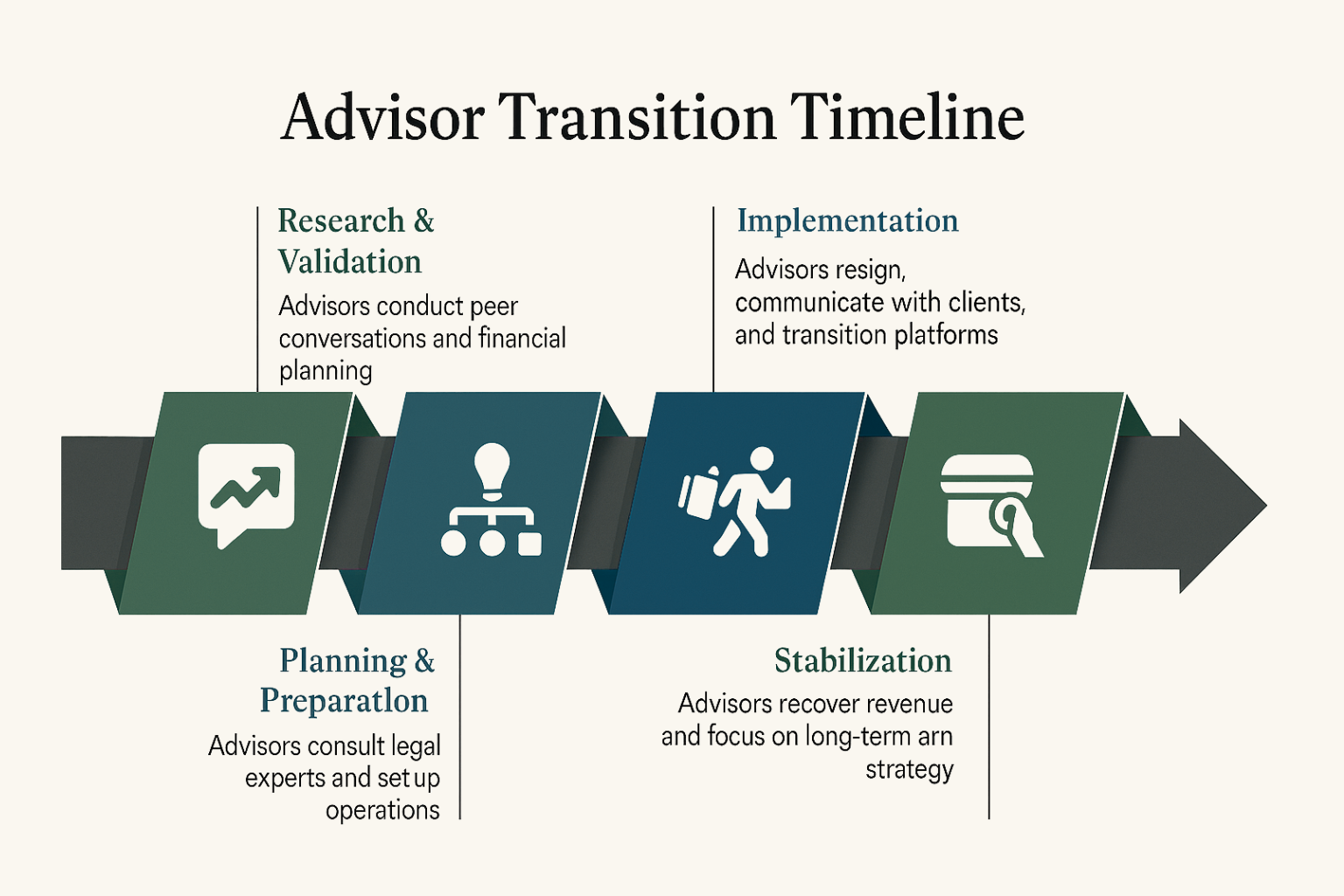
Based on our research, advisor transitions typically follow this general pattern:
Research and Validation Phase (6-12 months)
● Initial exploration and information gathering
● Multiple conversations with peers who've transitioned
● Evaluation of different firm options
● Financial scenario planning
Planning and Preparation (3-6 months)
● Legal consultation and employment agreement review
● Relationship strengthening with current clients
● Operational planning and setup
● Timeline development
Implementation (Variable)
● Resignation and formal transition
● Client communication (method varies by protocol status)
● Operational setup completion
● Service re-establishment
Stabilization (6-12 months)
● Client relationship continuation
● Practice optimization
● Revenue stabilization
● Long-term growth planning
Our research indicates that advisors prefer to start transitions during slower business periods to minimize disruption to client service.
KEY CONSIDERATIONS FOR YOUR DECISION
Questions to Ask Yourself
Based on our research with advisors in transition, important self-assessment questions include:
Professional Identity: Does my current environment allow me to be the advisor I want to be?
Client Service: Can I serve my clients in the way they deserve and I know they need?
Financial Sustainability: Is my current compensation model building toward financial freedom or perpetuating income volatility?
Values Alignment: Does my daily work align with my professional values and ethical standards?
Long-Term Vision: Where do I want to be in 5-10 years, and does my current path lead there?
Questions to Ask Prospective Firms
Our research suggests these critical due diligence questions:
Business Model: What percentage of your revenue is recurring versus transactional?
Ownership: Do advisors truly own their client relationships and practice equity?
Support Structure: What operational support is provided for compliance, technology, and administration?
Transition Support: What specific assistance is provided during the transition process?
Track Record: Can I speak with advisors who have been with your organization for 3-5+ years about their actual experience?
Costs and Fees: What are all costs, both upfront and ongoing, with complete transparency?
TAKING THE NEXT STEP
Educational Consultation
If you're considering a transition and want to better understand your options, we offer confidential consultations where we can:
● Discuss the general landscape of protocol vs non-protocol considerations
● Help you understand questions to ask legal counsel
● Explain Axiom's model and determine if it might be a fit
● Answer questions about the transition planning process
This consultation is educational only and creates no obligation.
Schedule Your Free Consultation:
📞 Call: (800) XXX-XXXX
📧 Email: transitions@axiomfinancial.com
IMPORTANT DISCLAIMERS
Regardless of whether an advisor avails themselves of Broker Protocol, they should share with their counsel copies of all contracts/agreements they signed with their existing firm for review of confidentiality/privacy obligations.
Legal Disclaimer
This article is intended for informational and educational purposes only and does not constitute legal advice. Laws and regulations governing advisor transitions vary by state and situation. Always consult with a qualified attorney who specializes in advisor transitions before taking any action.
Results Disclaimer
Individual transition experiences vary significantly based on numerous factors including firm policies, state laws, employment agreements, client relationships, and personal circumstances. Past outcomes are not predictive of future results.
Axiom makes no guarantees regarding client retention, income levels, legal outcomes, or any other results of advisor transitions. All advisors considering transitions should conduct thorough due diligence with appropriate legal, financial, and professional advisors.
Protocol Status Disclaimer
Protocol status of firms can change at any time. Advisors should verify current protocol membership status with legal counsel before making any transition plans.
Research Disclaimer
Research findings and advisor experiences cited in this article are based on our internal research and documented advisor interviews. Individual experiences vary, and these should not be construed as typical results or guarantees of specific outcomes.
CRN202901-9857423
SOURCES AND REFERENCES
All claims in this article are substantiated by the following internal research documents, which are available for compliance review:
Internal Documentation:
- Advisors_in_transition_research_ - Main Document This document contains: Advisor Identity Fracture concept, psychological profiles, decision timelines, ROI expectations (18-24 months), validation requirements, operational complexity concerns, and advisor interview transcripts.
- Advisors in transition research (2) (Firm-Specific Research) This document contains: Northwestern Mutual statistics from Diamond Consultants (80% attrition within 5 years, nearly 1,000 advisors left since 2017), pain points for wirehouse firms (Morgan Stanley, UBS, Wells Fargo), independent broker-dealers (LPL, Raymond James, Ameriprise), and insurance companies.
- Jerry_Zoom_Interview_Script This document contains: 97% recurring revenue statement for Axiom's organization, 32% industry average claim, philosophy about advisor freedom, "commission based treadmill" quote, and compensation model details.
- Axiom POD 1.docx - Advisor Testimonials This document contains: Documented advisor testimonials about transition experiences, fee-based planning benefits, and recurring revenue advantages.
Third-Party Research Cited:
- Diamond Consultants Referenced in our Advisors in Transition Research for Northwestern Mutual statistics: 80% of field recruits leave within first 5 years, top 5 reasons advisors leave Northwestern Mutual, and nearly 1,000 advisors departures since 2017.
Research Methodology Note: Insights about advisor pain points, decision patterns, and psychological factors are derived from our internal qualitative research with advisors in transition. These represent documented themes and patterns from advisor interviews, not statistical surveys or peer-reviewed academic studies.
PRIMARY RESEARCH SOURCES:
- Advisors in Transition Research - Main Document Download: Source advisors in transition research main (Contains: Advisor Identity Fracture, ROI expectations, decision timelines, psychological research)
- Advisors in Transition Research - Part 2 (Firm-Specific) Download: Source advisors in transition research 2 · (Contains: 80% Northwestern Mutual stat, Diamond Consultants citation, all firm pain points)
- Jerry Zoom Interview Transcript Download: Jerry Zoom Interview (Contains: 97% recurring revenue, 32% industry average, commission treadmill quote)
- Axiom POD 1 - Advisor Testimonials Download: SOURCE_Axiom_POD_1_Testimonials (Contains: Actual advisor testimonials and transition experiences)
COMPLIANCE SUPPORT DOCUMENTS:
- Compliance Package Index Download: COMPLIANCE_PACKAGE_INDEX (Shows exactly what's in each research file and how to find specific claims)
- Source Verification Document Download: SOURCE_VERIFICATION_Every_Research_Claim (Maps every blog claim to exact source location)
- Compliance Cheat Sheet Download: COMPLIANCE CHEAT SHEET - Quick Answers (Quick reference for compliance questions)
Related Articles:
- Breaking Through the Solo Ceiling: A Guide to Building Enterprise-Level Advisory Firms
- Breaking Through the Hamster Wheel: The 5 Phases of Building a Sustainable Financial Advisory Practice
- How to Build a Never-Asking-For-Referrals Business