.jpg)
Table of content
COMPLIANCE DISCLAIMERS:
● This article is for informational and educational purposes only
● Individual results vary significantly based on production level, business decisions, market conditions, and operational efficiency
● All financial projections and examples are hypothetical and do not represent guaranteed outcomes
● Readers should conduct their own due diligence and consult with qualified professionals before making career transitions
● Past performance and hypothetical scenarios do not guarantee future results
Choosing the right financial advisor business model—RIA vs IBD vs wirehouse—is one of the most important career decisions you'll make. Yet most advisors make this choice based on recruiter promises rather than comprehensive analysis.
This guide provides a comprehensive breakdown of financial advisor business models with detailed frameworks to help you make an informed decision based on your unique situation. You'll explore key economic considerations of each model—including common cost categories advisors may overlook—a step-by-step decision framework to evaluate which structure aligns with your goals, and real-world insights from advisors who have made the transition successfully.
Ready to determine which model aligns with your practice goals? Contact us to discuss your specific situation and get guidance on evaluating RIA, IBD, and wirehouse options.
Understanding Your Options: The Three Main Models
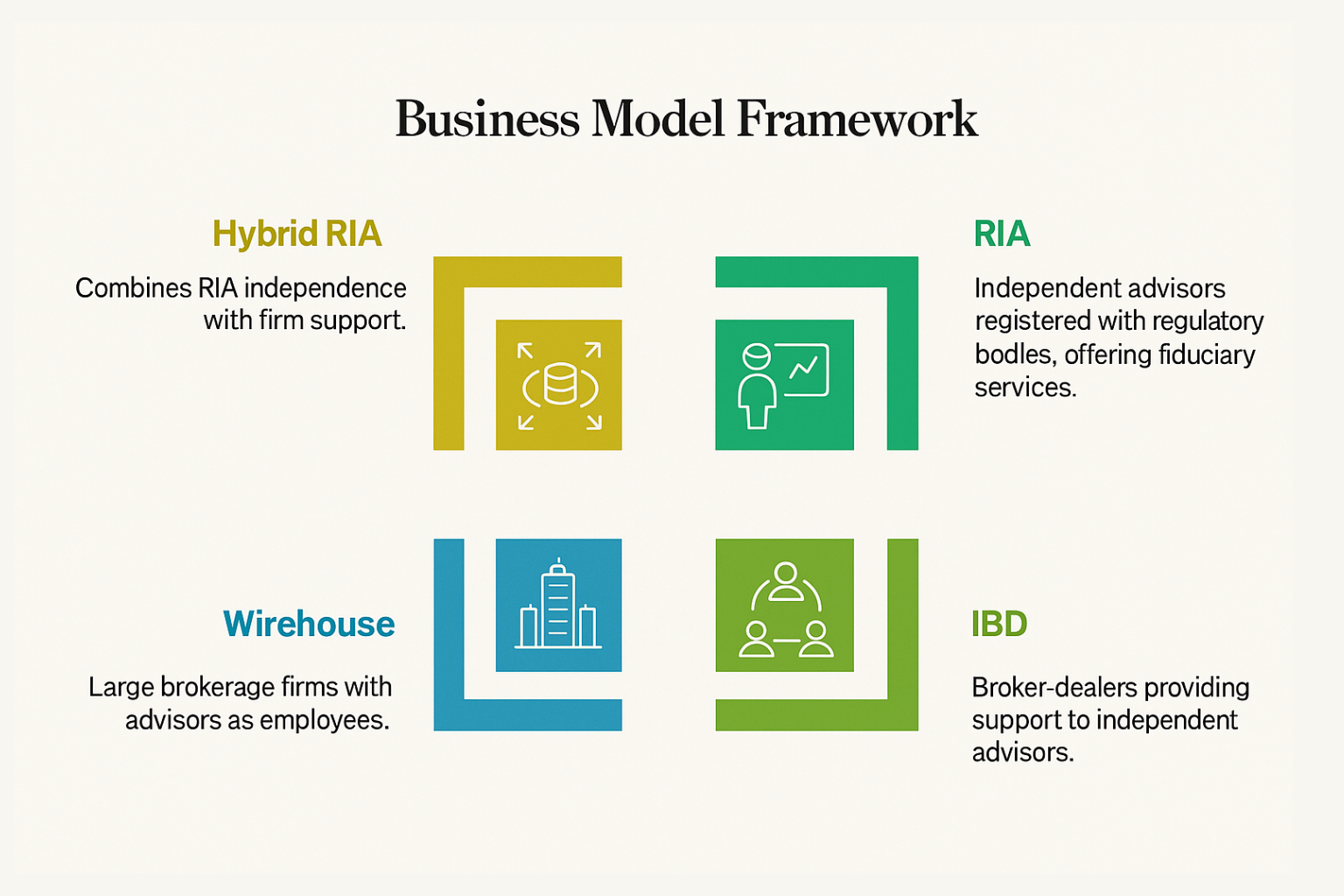
Before diving into comparisons, let's establish clear definitions of each business model.
What is an RIA (Registered Investment Advisor)?
An RIA (Registered Investment Advisor) is a firm or individual registered with the SEC or state securities regulators to provide investment advice for fees. As an RIA, you're a fiduciary with legal obligation to act in clients' best interests.
Key Characteristics:
● You own your own firm
● You're registered directly with SEC/state
● You're held to fiduciary standard
● You have complete independence and control
● You have complete responsibility for operations
What is an IBD (Independent Broker-Dealer)?
An IBD (Independent Broker-Dealer) is a broker-dealer firm that provides infrastructure, compliance, and back-office support to affiliated independent advisors who operate their own practices.
Key Characteristics:
● You're an independent contractor
● You're affiliated with a broker-dealer
● You have access to BD platform and support
● You share compliance burden
● You operate within platform guidelines
What is a Wirehouse?
A wirehouse is a large, full-service brokerage firm where advisors are employees operating under the firm's brand, infrastructure, and business model.
Key Characteristics:
● You're an employee
● You use firm's brand and infrastructure
● You have high level of operational support
● You operate within significant restrictions
● You typically do not build transferable equity
The Hybrid RIA Model
A fourth option is the Hybrid RIA model, which combines RIA independence with firm support.
Key Characteristics:
● You own your RIA (or operate under firm's RIA)
● You're affiliated with a supporting organization
● You get operational support
● You maintain significant independence
● Advisors in certain models may have the opportunity to build equity in their practice, depending on how the business is structured and managed. This is not guaranteed and is subject to factors like client retention, profitability, and legal arrangements.
Registered Investment Advisor (RIA) Model Deep Dive
RIA Structure and Compensation
How It Works:
● You establish your own RIA firm
● You register with SEC (if $100M+ AUM) or state
● You create your own business entity
● You maintain your own compliance
● You keep the full revenue (minus expenses)
Compensation Considerations:
● Gross Revenue: 100% (all revenue is yours)
● Operating Expenses: Typically range from 35-50% of revenue depending on scale and efficiency
● Net Income: Varies significantly based on your operational efficiency
Note: Net income percentages can vary widely based on practice size, operational efficiency, and business decisions. Solo RIAs often face higher percentage costs relative to revenue due to lack of scale.
RIA Model Advantages
1. Complete Independence
● No product restrictions
● Freedom to use any custodian
● Ability to offer any service model
● Complete decision-making authority
2. True Fiduciary Status
● Legal obligation to clients
● No inherent conflicts from product sales
● Clean fee-based business model
3. Equity Building Potential
● Own 100% of your business
● Depending on how the business is structured and client relationships are maintained, some advisors may be able to develop a practice with transferable equity. However, this outcome is not guaranteed and depends on legal, contractual, and operational factors.
● Retain full value at transition or exit
4. Maximum Client Service Flexibility
● Design your own service model
● Set your own fee structures
● Choose your areas of focus
● Advisors operating independently may have more flexibility to shape their service offerings and business strategy. However, success in executing a personal vision depends on a range of factors including market demand, operational capacity, and client acquisition effectiveness.
5. Tax Planning Opportunities
● S-Corp or other entity structure options
● Business expense deductions
● Qualified Business Income deduction potential
● Flexible retirement contribution options
RIA Model Challenges
Complete Responsibility Managing all aspects of compliance, technology, operations, accounting, marketing, HR, and legal requirements. This can require significant time on non-revenue activities.
Substantial Costs
Startup and ongoing expenses can be significant, including:
● Technology infrastructure
● Compliance and regulatory costs
● E&O insurance
● Legal and accounting services
● Marketing and business development
● Working capital reserves
Note: Actual costs vary widely based on business model, location, and service offerings. Some advisors report startup costs for launching a solo RIA ranging from $50,000 to over $100,000, depending heavily on the specific business model, location, and scope of services. These figures are illustrative only and not representative of typical or guaranteed outcomes. Actual costs may be higher or lower based on individual decisions.
Learning Curve
Some advisors report that it can take 6 to 12 months or more to become operationally efficient after transitioning. This estimate is based on anecdotal reports and varies widely. It should not be interpreted as a typical or expected timeframe.
Revenue may be impacted during this transition phase.
Full Compliance Burden
As the principal, you bear complete responsibility for regulatory compliance, SEC/state audits, and keeping current with regulatory changes.
Best Candidates for Solo RIA
You may want to consider if Solo RIA if you have:
● Significant production (specific thresholds vary by market and model)
● High risk tolerance and comfort with uncertainty
● Strong operational skills or willingness to develop them
● Business acumen and CEO mindset
● Sufficient capital for startup and operating reserves
● High desire for control and independence
● Clear vision for what you want to build
Independent Broker-Dealer (IBD) Model Analysis
IBD Structure and Compensation
How It Works:
● You affiliate with an IBD as an independent contractor
● You maintain operational independence
● You use the BD's compliance infrastructure
● You receive varying levels of operational support
● Compensation varies based on production and platform
Compensation Considerations:
● Payout percentages vary significantly across IBDs and by production level
● Platform fees and technology costs apply
● Net compensation depends on specific IBD terms and your business structure
IBD Model Advantages
1. Operational Support
● Back-office operations assistance
● Compliance infrastructure provided
● Technology platform included
● Supervision support
2. Regulatory Relief
● BD maintains licenses and registrations
● Compliance team monitors activity
● Risk management support available
● Audit assistance provided
3. Balanced Independence
● More freedom than wirehouse employment
● Less operational burden than solo RIA
● Reasonable flexibility within platform guidelines
4. Access to Resources
● Trading capabilities
● Investment platform access
● Research resources
● Product availability
5. Business Support
● Marketing resources (varies by IBD)
● Practice management consulting
● Technology training
● Peer community access
IBD Model Challenges
Platform Limitations
Product and technology restrictions, process requirements, and administrative procedures can limit flexibility.
Fee Structures
Various platform fees, technology charges, and administrative costs can affect net compensation. Careful analysis of total cost structure is important
Limited Full Independence
Major decisions may require review or approval. Certain activities may have restrictions.
Variable Quality
IBD quality, support levels, and culture vary significantly across firms. Thorough due diligence is critical.
Best Candidates for IBD Model
You may want to consider IBD if you:
● Want a balance of support and independence
● Prefer not to handle all operational aspects
● Value having infrastructure provided
● Seek compliance and regulatory support
● Have moderate risk tolerance
● Want to focus primarily on advising
Wirehouse Model Overview
Wirehouse Structure and Compensation
How It Works:
● You're an employee of the firm
● You operate under the firm's brand
● You use complete firm infrastructure
● Compensation typically follows a grid system
● You do not build transferable equity in client relationships
Compensation Considerations:
● Compensation structures vary by firm and production level
● Grid-based systems typically apply
● Deferred compensation programs may be offered
● Benefits packages typically included
Wirehouse Model Advantages
1. Brand Recognition
● Established firm reputation
● Marketing support
● Institutional presence
2. Complete Infrastructure
● Full back-office support
● Comprehensive compliance resources
● Extensive technology platforms
● Research departments
● Structured training programs
3. Minimal Capital Requirements
● No startup costs required
● Firm provides all resources
● Immediate operational capability
4. Structured Environment
● Established processes and workflows
● Defined systems
● Support staff access
Wirehouse Model Challenges
Limited Equity Building
As an employee, you typically do not own transferable client relationships or build sellable business equity.
Product and Platform Restrictions
May include proprietary product requirements, platform limitations, and service restrictions.
Compensation Structure
Grid-based systems with various adjustments. Important to understand total compensation picture.
Deferred Compensation Considerations
Many wirehouses offer deferred compensation programs with specific vesting schedules and retention requirements.
Cultural Factors
Production-focused environments with metrics and performance tracking.
Best Candidates for Wirehouse
You may fit best at a wirehouse if you:
● Are early in your advisory career
● Value maximum infrastructure support
● Prefer employee status with benefits
● Want established brand recognition
● Have very low risk tolerance
● Prefer highly structured environment
The Hybrid RIA Model: A Middle Path
How Hybrid RIA Works
The Hybrid RIA model combines RIA independence with organizational support:
Structure:
● You own your RIA (or operate under firm's RIA)
● You affiliate with a supporting organization
● You maintain independence and significant control
● You access shared infrastructure and resources
● You keep majority of revenue while receiving support
Example: Axiom's Hybrid RIA Approach
Axiom Financial operates a hybrid RIA model with specific characteristics This example is provided for illustrative purposes. Other firms may offer different structures, features, or levels of support.
Substantiated Claims:
● 97% Recurring Revenue Structure: According to internal Axiom Financial data, 97% of its investment advisory revenue is recurring. This figure reflects Axiom’s unique business model and internal reporting. It is not independently verified and may not be typical of other firms or advisors. Individual outcomes vary based on numerous factors including business structure and client base.
Model Features:
● Advisors own their client relationships
● Comprehensive operational support provided
● Integrated compliance infrastructure
● Technology platform included
● Practice management resources available
● Transition services offered
Support Structure:
● Full operations team
● Complete compliance infrastructure
● Technology platform access
● Planning department resources (fee-based services)
● Marketing support
● Practice management consulting
Compensation Approach:
● Platform fee structure (specific terms vary by advisor arrangement)
● Support services included in platform fee
● Simplified fee structure with transparency
Philosophy:
Axiom emphasizes a "Volunteer Not Hostage" philosophy, meaning:
● No mandatory deferred compensation programs
● No long-term retention handcuffs
● Advisors stay by choice based on value received
● Career freedom prioritized
Hybrid RIA Advantages
vs. Wirehouse:
● Some advisors report that models with greater independence may offer the opportunity for higher net compensation. However, actual income depends on factors such as business expenses, operational efficiency, client base, and service model. Individual results vary.
● True business ownership opportunity
● Greater practice independence
● Fiduciary-first business model
vs. IBD:
● Comprehensive operational support
● Emphasis on recurring revenue model
● Potentially simplified infrastructure
vs. Solo RIA:
● Full operational support provided
● Reduced time on administrative tasks
● Shared compliance resources
● Lower risk profile for operations
Hybrid RIA Considerations
Not Completely Independent
You work within the supporting organization's framework with some guidelines and standards.
Platform Fee
A percentage of revenue goes to the supporting organization in exchange for services and infrastructure.
Cultural Fit Requirement
Success requires alignment with the organization's values and approach.
Not Suitable for Everyone
May not be ideal for those seeking either complete independence or maximum structure and support.
Decision Framework: Which Model Fits You?
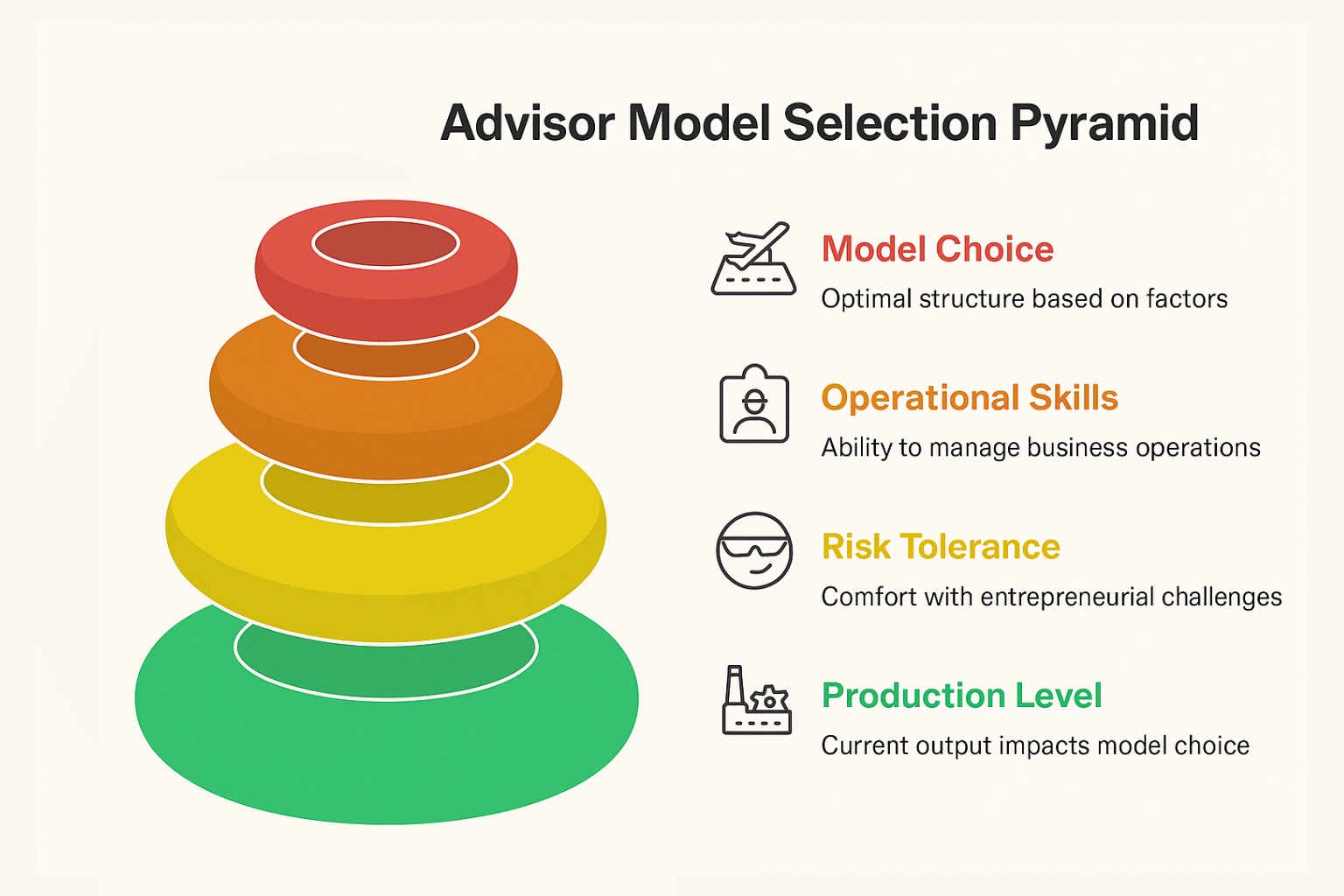
Step 1: Assess Your Production Level
Your current production significantly impacts which model makes sense:
● Lower Production: May benefit most from wirehouse structure and training
● Growing Production: IBD or Hybrid RIA may provide optimal balance
● Established Production: More options become viable including Solo RIA or Hybrid RIA
● High Production: For some established advisors, the Solo RIA or Hybrid RIA model may offer greater flexibility and potential for ownership. However, these models also come with higher responsibility and risk. Whether they are advantageous depends on individual goals, production levels, and risk tolerance.
Note: Specific production thresholds vary by market, location, and individual circumstances.
Step 2: Evaluate Your Risk Tolerance
Low Risk Tolerance:
● Consider wirehouse or established IBD
● Avoid solo RIA startup risk
● Hybrid RIA may offer middle ground
Moderate Risk Tolerance:
● IBD or Hybrid RIA often good fits
● Consider solo RIA if production supports it
● Balance risk against opportunity cost
High Risk Tolerance:
● Solo RIA or Hybrid RIA viable
● Comfortable with entrepreneurial challenges
● Ensure business skills match advisor skills
Step 3: Assess Operational Capabilities
Limited Operational Skills:
● Choose wirehouse, IBD, or Hybrid RIA
● Avoid solo RIA
● Focus on advisor activities, not operations
Moderate Operational Skills:
● IBD or Hybrid RIA typically best fit
● Solo RIA possible if operationally passionate
● Consider time allocation preferences
Strong Operational Skills:
● Solo RIA or Hybrid RIA based on preference
● Can succeed in either structure
● Evaluate time value and opportunity cost
Step 4: Determine Control Requirements
Maximum Control:
● Solo RIA only option
● Accept full operational responsibility
● Value autonomy above support
High Control:
● Hybrid RIA often optimal
● Accept some framework
● Balance autonomy with support
Moderate Control:
● IBD or Hybrid RIA appropriate
● Accept more structure
● Value support alongside freedom
Structure Preferred:
● Wirehouse or established IBD
● Accept significant restrictions
● Value clarity and defined systems
Comparing the Models: Key Factors
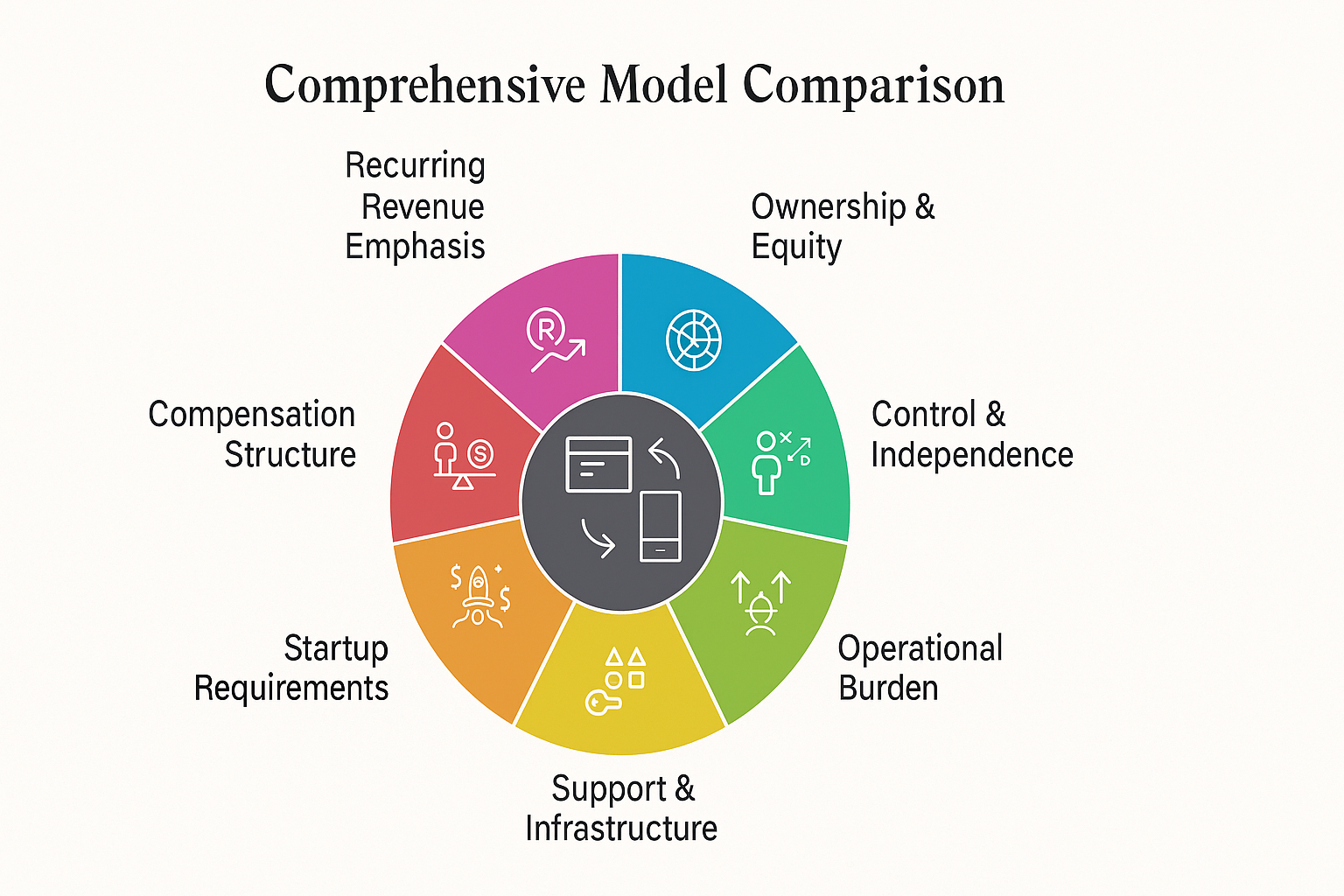
RIA vs IBD vs Wirehouse Comparison
Ownership & Equity
● Wirehouse: Employee, no transferable equity
● IBD: Independent contractor, limited equity
● Solo RIA: Full ownership, with potential for equity value depending on client retention, business performance, and other factors
● Hybrid RIA: Full ownership with platform support
Control & Independence
● Wirehouse: Minimal independence
● IBD: Moderate independence
● Solo RIA: Maximum independence
● Hybrid RIA: High independence with guidelines
Operational Burden
● Wirehouse: Minimal (firm handles)
● IBD: Moderate (shared responsibility)
● Solo RIA: Maximum (full responsibility)
● Hybrid RIA: Low to moderate (support provided)
Support & Infrastructure
● Wirehouse: Maximum support
● IBD: Moderate to substantial support
● Solo RIA: Self-managed
● Hybrid RIA: Comprehensive support
Startup Requirements
● Wirehouse: None
● IBD: Moderate capital needed
● Solo RIA: Significant capital needed
● Hybrid RIA: Varies by arrangement
Compensation Structure
● Varies significantly across all models
● Important to analyze total economics, not just payout percentages
● Consider both immediate compensation and long-term wealth building
Recurring Revenue Emphasis
● Varies by firm and model
● Recurring revenue models provide income stability
● Transaction-based models create income volatility
● Axiom's 97% recurring revenue structure represents their specific emphasis on advisory fees[1]. These figures reflect Axiom’s internal reporting and are not indicative of industry norms. Results vary widely across firms.
Important Considerations
The Hidden Costs of Career Decisions
Every business model has both obvious and hidden costs:
Time Costs:
● Administrative burden varies significantly
● Non-revenue activities impact income potential
● Work-life balance implications
Opportunity Costs:
● Lower compensation compounds over decades
● Lack of equity building affects retirement
● Restricted service models limit practice growth
Psychological Costs:
● Production pressure affects quality of life
● Ethical conflicts create moral injury
● Career satisfaction impacts longevity
Why Advisors Transition
Common career trajectory patterns:
Early Years (1-5):
● Learning the business
● Building skills and confidence
● Growing production
● Often at wirehouse or insurance-focused firm
Mid-Career (5-15):
● Experiencing platform limitations
● Questioning compensation structures
● Considering independence options
● Evaluating long-term wealth building
Established (15-25):
● Seeking maximum efficiency
● Building exit value
● Optimizing service model
● Preparing for succession
Pre-Retirement (25-30+):
● Evaluating sellable assets
● Planning transition or exit
● Considering legacy and succession
Making Your Decision
Key Questions to Answer:
- Production: What is your current and projected production?
- Risk: What level of uncertainty can you tolerate?
- Operations: Do you want to manage operations or focus on clients?
- Control: How important is complete independence vs. support?
- Capital: What resources do you have for transition?
- Time: How much time can you dedicate to building infrastructure?
- Vision: What does your ideal practice look like?
Next Steps:
- Self-Assessment: Honestly evaluate your situation, skills, and preferences
- Research: Gather detailed information on specific firms and models
- Analysis: Run your own economic scenarios
- Consultation: Speak with advisors who have made transitions
- Professional Advice: Consult with attorneys, accountants, and consultants
- Due Diligence: Thoroughly investigate any potential moves
- Decision: Make an informed choice based on comprehensive analysis
Ready to explore your options? Contact us to continue the conversation about which business model is right for your practice and how we can support your transition decision.
Frequently Asked Questions
Q: What is the difference between RIA and IBD?
An RIA is an independent firm registered directly with the SEC/state offering fiduciary investment advice with complete operational independence and responsibility. An IBD is a broker-dealer platform where advisors affiliate as independent contractors, receiving operational support in exchange for platform fees and working within certain guidelines.
Q: Which model typically offers the highest compensation?
Compensation varies significantly based on individual circumstances, production level, business structure, and operational efficiency. Net income depends on many factors beyond gross payout percentages. Solo RIAs have highest gross revenue potential but also highest costs. The optimal model for compensation depends on your specific situation.
Q: How much does it cost to start an RIA?
Startup costs vary significantly based on business model, location, and scale. Industry sources suggest costs can range from $50,000-$100,000+ for solo RIAs, but actual costs depend heavily on individual circumstances and business decisions.
Q: What production level makes sense for independence?
There is no single threshold. The right production level depends on your market, expense structure, risk tolerance, and business model. Generally, higher production provides more flexibility and options, but many factors affect the decision beyond production alone.
Q: Can I maintain my client relationships when transitioning?
Client retention varies significantly based on relationship quality, communication approach, regulatory environment (broker protocol vs. non-protocol), and specific circumstances. Many advisors successfully transition clients, but outcomes vary. Professional transition planning and legal advice are essential.
Q: What is the advantage of a hybrid RIA model?
Hybrid RIA models attempt to combine independence and ownership with organizational support and infrastructure. This can provide a balance between the complete independence of solo RIA and the full support of wirehouse or IBD models. Suitability depends on individual preferences and circumstances.
Conclusion
The choice between RIA, IBD, wirehouse, or hybrid RIA models is highly personal and depends on your unique circumstances, goals, risk tolerance, and preferences. There is no universally "best" model – only the model that best fits your specific situation.
Key takeaways:
● Understand all models thoroughly before deciding
● Consider total economics, not just payout percentages
● Evaluate both short-term and long-term wealth building
● Assess operational capabilities honestly
● Consider work-life balance and career satisfaction
● Seek professional advice for transitions
● Make decisions based on your unique circumstances
A well-informed decision aligned with your personal and professional goals is critical. However, no model guarantees success, and outcomes depend on many factors including advisor skillset, client relationships, and operational strategy.
Compliance and Disclaimers
Important Disclaimers:
● This article is for informational and educational purposes only
● It does not constitute financial, legal, investment, or professional advice
● Individual results vary significantly based on numerous factors
● All examples, projections, and scenarios are hypothetical
● Past performance does not guarantee future results
● Readers should conduct independent due diligence
● Consult with qualified professionals before making career decisions
● No guarantees are made regarding outcomes of business model choices
About the Information:
Information in this article comes from various sources including industry research, advisor interviews, and company information. Specific claims marked with [source] numbers are substantiated by available documentation. All other information is provided for educational purposes and should be independently verified.
Sources and References
[1] 97% Recurring Revenue and 32% Industry Average:
Source Documents:
● Jerry_Zoom_Interview_Script (Interview with Jerry Corless, CEO, Axiom Financial)
○ Timestamp [00:38:59]: "Our, so ours is 97 percent recurring..."
○ Timestamp [00:36:16]: "97 percent of our 27 million in annual investment revenue, 97 percent of it is recurring"
○ Timestamp [00:39:12]: "Nationally with MassMutual, we're 97 percent recurring, 32 percent recurring for the country"
● Jerry’s Tone of Voice Document
○ Data Points section confirms: "Jerry's firm, Axiom, operates with 97% recurring revenue, significantly higher than the industry standard of 32%" https://docs.google.com/document/d/1laz0O3D8t4cEKR4TkaSEWXh8
Additional Information Sources:
General industry information and advisor experiences referenced from:
● Advisors_in_transition_research_ (Internal research documents on advisor transitions and industry practices)
● Derek_interview_script(Interview with Derek, CFO, Axiom Financial - regarding operational support and company practices)
● videosummaryclientchris.txt(Advisor interview regarding practice management and support)
● Bryan_Advisor_interview_Script (Advisor experience and transition insights)
● Axiom _ Comprehensive Macro Marketing Document pt1.docx (Company positioning and value propositions)
Methodology:
Information compiled from internal company documentation and advisor interviews conducted for research purposes.
Important Note: This article is based on internal research and company data. Readers should independently verify all information and consult with qualified professionals for their specific situations.
Related Articles: