
Table of content
Introduction
Bryan sat in his office after another long week at a well-known RIA, feeling the weight of a decade in the business. Ten years in, and his revenue was $130,000—far from the $400,000-$500,000 he’d hoped for when he started.
"I can't keep doing this. I got into this profession to help people, not push products."
The thought of changing firms was daunting. What about his clients? The 16-year vesting schedule meant walking away from everything he’d built. Where would he even start with the transition process?
If you’re like Bryan—ready for change but overwhelmed—this financial advisor transition checklist breaks down exactly what to do, step by step.
All advisor stories, including Bryan’s, represent individual cases. Other advisors’ results may differ significantly. Past performance does not guarantee future results.
Understanding the Advisor Transition Process
A financial advisor transition means moving your practice from one firm to another. It involves relocating your client relationships, revenue streams, and business infrastructure to a new platform.
Key Transition Considerations
Client Retention: Advisors seek partners with proven track records of high client retention.
Income Impact: Advisors typically need to see income recovery within 18–24 months to justify transition costs.
Legal Risk: Manageable with proper planning and specialized legal counsel.
Success Factors: Following a systematic approach rather than making impulsive moves.
Before You Start: Critical Pre-Transition Considerations
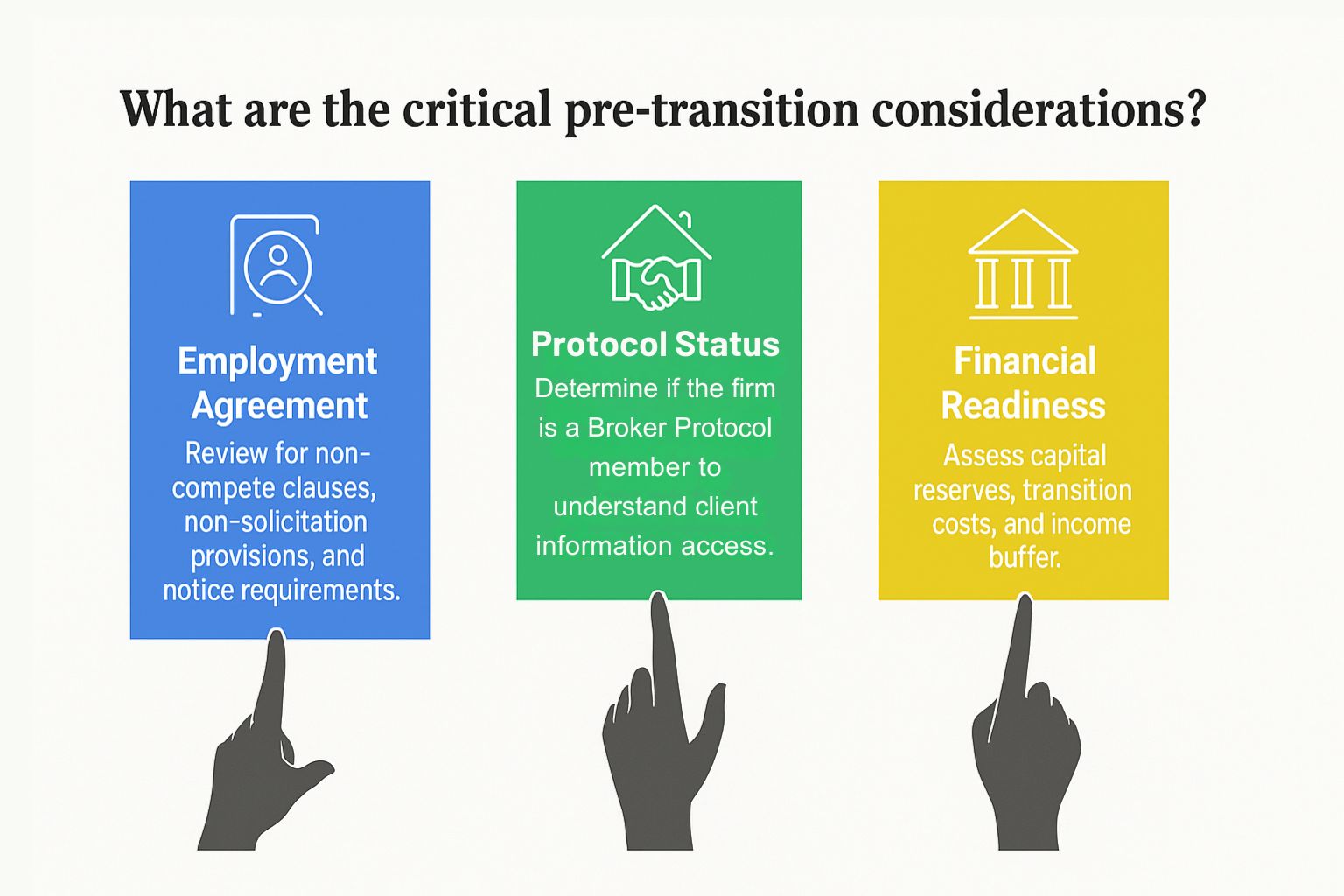
1. Your Employment Agreement and Restrictive Covenants
Review your employment agreement for:
● Non-compete clauses and geographic restrictions
● Non-solicitation provisions
● Forfeitable loans and deferred compensation at risk
● Notice requirements
Key questions to answer:
● Do you have a non-compete? What are the geographic and time restrictions?
● Can you contact clients after leaving, or must they contact you first?
● How much deferred compensation will you forfeit?
● How much notice are you required to give?
● What client information can you legally take with you?
Real Example: One advisor we interviewed had a 16-year vesting schedule at a well -known RIA, which significantly impacted his transition decision-making process.
Advisors must comply with all contractual and regulatory restrictions regarding client communication during transitions. Consult legal counsel before contacting clients.
2. Protocol vs. Non-Protocol Status
Protocol status varies by firm. Advisors should verify their firm's current status and consult legal counsel for guidance.
Protocol Firms: May allow certain client information to be taken when leaving.
Non-Protocol Firms: Restrictions may be stricter; legal counsel is essential.
Advisors should verify all information independently.
3. Financial Readiness Assessment
Advisors considering transitions typically need:
● Operating capital reserves
● Budget for transition costs
● Income buffer period
● Legal defense fund (especially for non-protocol transitions)
The 12-Step Financial Advisor Transition Checklist
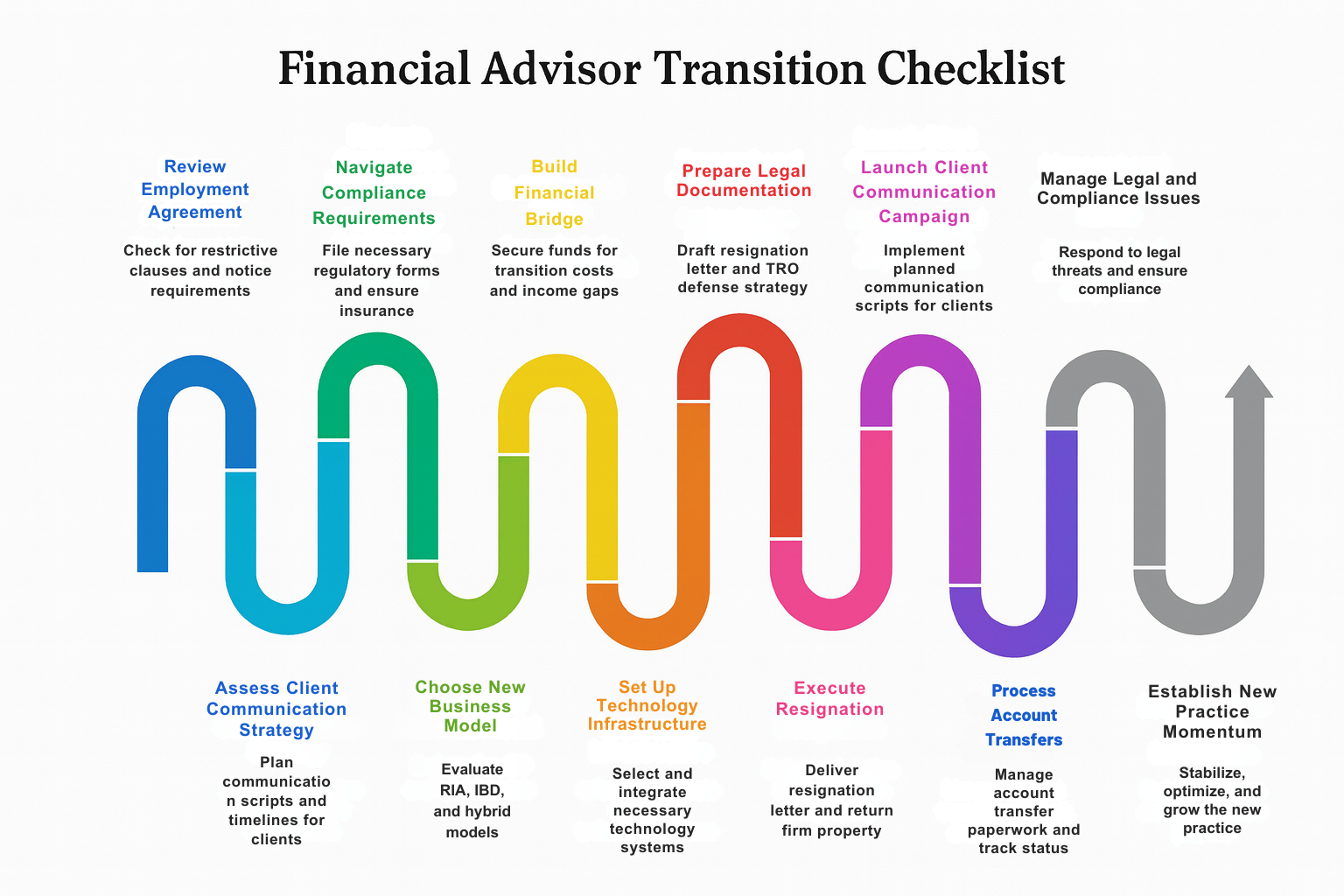
Step 1: Review Your Employment Agreement and Non-Compete Clauses
● Locate your original employment agreement
● Identify all restrictive covenants
● Document all deferred compensation and forfeiture provisions
● Note all notice requirements
● Schedule consultation with transition-specialized attorney
Step 2: Assess Your Client Communication Strategy
● Segment your client base (A, B, C clients)
● Identify clients most likely to follow
● Develop communication scripts foreach segment
● Plan your announcement timeline
● Prepare explanation of why you ’removing
Advisors must comply with all legal and contractual restrictions regarding client communication.
Step 3: Navigate Compliance Requirements and Regulatory Considerations
● Determine your new regulatory status (RIA, hybrid, IBD)
● Understand Form U5/U4 requirements
● Research ADV requirements (if becoming RIA)
● Verify necessary licenses (Series65, state registrations)
● Ensure E\&O insurance continuity
Step 4: Choose Your New Business Model
● Compare RIA vs. IBD vs. Hybrid models
● Evaluate payout structures
● Assess technology and operational support
● Review equity and ownership options
Step 5: Build Your Financial Bridge
● Calculate operating expenses buffer
● Secure line of credit or liquid capital
● Explore transition financing options
● Build budget for transition costs
Step 6: Set Up Technology Infrastructure
● Select CRM system
● Choose portfolio management platform
● Select financial planning software
● Set up document management system
● Establish client portal solution
Step 7: Prepare Legal Documentation
● Hire transition-specialized attorney
● Prepare resignation letter
● Document defense strategy if applicable
● Organize client documentation(legally permissible information only)
● Review protocol compliance requirements
Step 8: Execute Your Resignation
● Schedule resignation meeting
● Deliver resignation letter (brief and professional)
● Return all firm property immediately
● Document everything
● Leave premises as required
Step 9: Launch Client Communication Campaign
● Personal calls or meetings for priority clients
● Systematic outreach for remaining clients
● Prepare clear, professional scripts
All communication must comply with legal and contractual requirements.
Step 10: Process Account Transfers
● Prepare and send account transfer paperwork
● Track transfer status
● Communicate with clients throughout process
Step 11: Manage Legal and Compliance Issues
● Respond promptly to any legal communications
● Communicate with old firm only through attorney if advised
● Document all interactions
Step 12: Establish New Practice Momentum
● Complete account transfers
● Resolve client concerns
● Implement new service model
● Resume business development
Transition Timeline: When to Change Firms
Advisors often prefer transitioning during slower business periods and avoid their busiest season, periods of market volatility, or major personal events.
Risk Mitigation During Firm Change Process
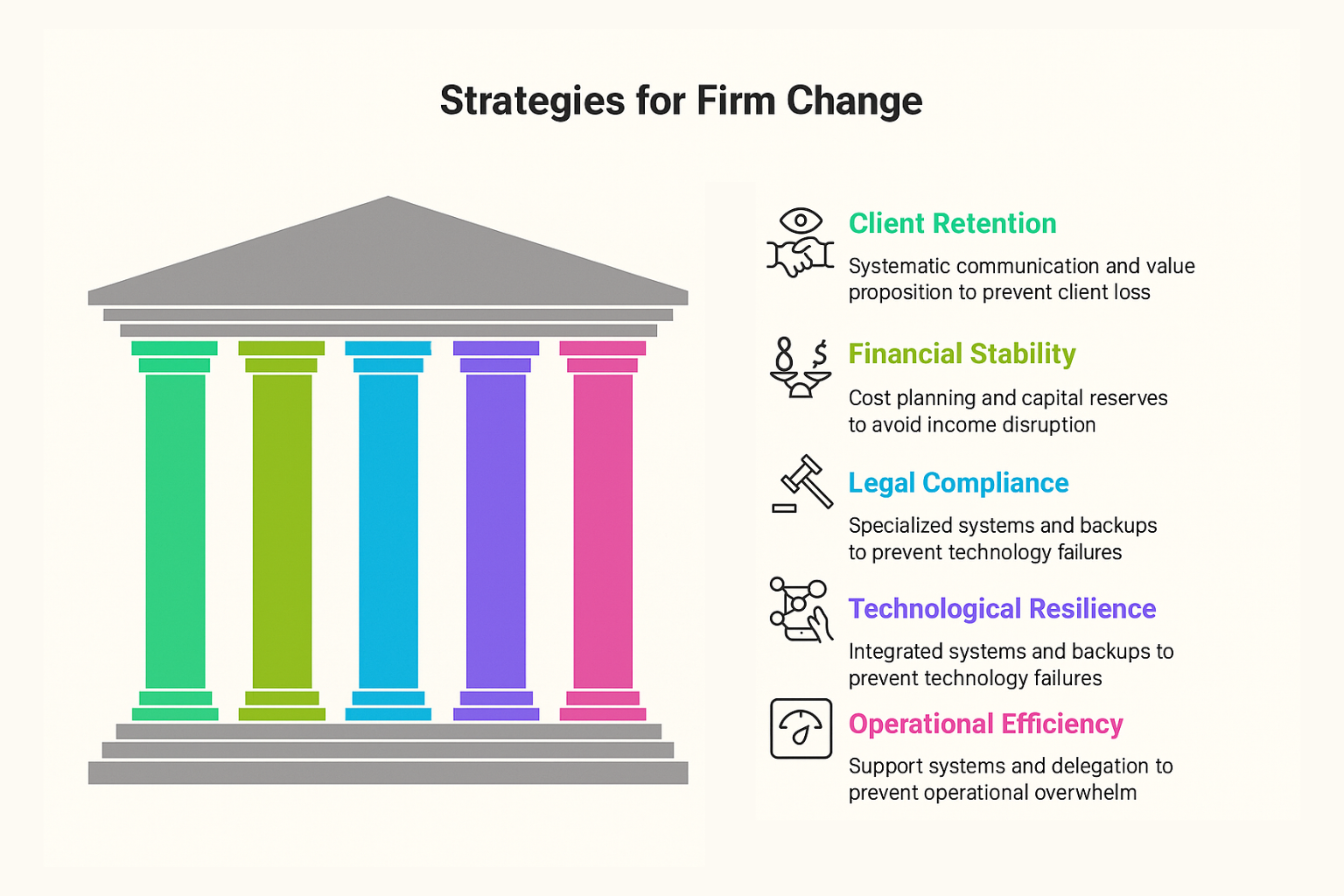
Primary Risks and Mitigation Strategies:
Client Loss: Systematic communication plan, professional approach, clear value proposition
Potential Income Disruption: Plan for costs, maintain capital reserves, and explore financing options
Legal Action: Specialized legal counsel, proper procedures, thorough documentation
Technology Failures: Integrated technology platforms, backup systems, support
Operational Overwhelm: Support systems, delegated operations, focus on client relationships
FAQ: Financial Advisor Transition Questions
Q: How long does a financial advisor transition take?
A Based on industry research, advisors expect 6-12 months for research and validation phase, 3-6 months for planning and preparation, and 6-12 months for implementation and stabilization. Actual timelines vary significantly based on practice complexity, firm protocols, and individual circumstances.
Q: What is the biggest risk when changing firms?
A: Advisors’ primary concerns include client retention, income disruption, and legal complications. Systematic planning and proper support significantly impact outcomes.
Q: What factors affect client retention during transitions?
A: Relationship quality, systematic communication approach, protocol status of previous firm, professionalism during transition, and value proposition of new arrangement.
Take Your Next Step
If you're considering a move, here are steps many advisors have followed to help support a smoother transition. Outcomes vary, and success depends on your individual situation.
Here's what advisors who successfully transition typically do:
✓ Review employment agreement (schedule attorney consultation)
✓ Calculate financial readiness
✓ Assess client base
✓ Evaluate current situation
✓ Connect with advisors who've made similar moves
Ready to Begin Your Transition Assessment?
Don't navigate this complex process alone. Our transition specialists have guided hundreds of advisors through successful firm changes while protecting their practices.
Take Your Next Step:
✓ Schedule your confidential transition consultation
✓ Get your personalized transition timeline
✓ Receive our complete transition toolkit
✓ Connect with advisors who've made similar moves
Contact Our Transition Specialists:
Email: [your email] Phone: [your phone]
The average consultation takes 30 minutes. Zero obligation. Complete confidentiality guaranteed.
Successfully transitioning requires careful planning and proper support. Evaluate your situation against this checklist and consult with transition specialists to determine your best path forward.
Compliance: Service offering only. No performance guarantees. Individual results vary.
Sources & Substantiation
All statistics and outcomes are based on documented research and advisor interviews. Individual results may vary.
● Advisors in Transition Research(publicly available summary)
● Documented Advisor Interview Transcripts (with permission)
● Industry statistics from recognized sources
No confidential or proprietary information is included. All external links are to publicly accessible resources.
This article is for educational purposes only. It does not constitute financial, legal, or professional advice. All advisor experiences and outcomes described are individual and not indicative of future results.
Related Articles: